

-
 author
- 18th September 2026

Laser clinics rarely treat identical patients. Hair depth changes from the upper lip to the back. Skin tone varies between customers. Coarse dark hair may sit beside fine hair. An alexandrite Nd:YAG laser brings a 755 nm Alexandrite source and a 1064 nm Nd:YAG source into one platform.
The useful part is choice. The operator can match the wavelength and pulse settings to the patient. Cooling and sequence are adjusted with them.
Quick Answer: How Does an Alexandrite Nd:YAG Laser Work?
An alexandrite Nd:YAG laser combines two wavelengths in one system. The Alexandrite channel operates at 755 nm and is absorbed strongly by melanin. The Nd:YAG channel operates at 1064 nm and travels deeper with lower epidermal melanin absorption.
Depending on the design, the machine may deliver one wavelength at a time. It may alternate or synchronize pulses. Shared controls and cooling support one workflow.
What Are the Differences Between 755 nm Alexandrite and 1064 nm Nd:YAG?
The two sources behave differently in tissue. That difference gives the platform its purpose.
755 nm Alexandrite wavelength
The 755 nm Alexandrite wavelength has a high affinity for melanin. Dark hair can absorb energy efficiently, allowing the pulse to heat the follicular target. Operators value it when skin and hair provide enough contrast. Additionally, it is highly suitable for removing fine, light-colored or blonde hairs.
The trade-off is real. Epidermal melanin can absorb energy. Fluence and pulse duration need careful selection. A summer tan cannot simply receive the winter protocol.
1064 nm Nd:YAG wavelength
The 1064 nm Nd:YAG wavelength penetrates more deeply. Its melanin absorption is lower than 755 nm, so it is often considered for darker skin types or deeper follicles under an appropriate protocol.
Nd:YAG is not automatically safer or better. Energy must reach the target without unnecessary heat in surrounding tissue. Cooling and a sensible test spot remain part of professional operation.
Why the two wavelengths complement each other
Alexandrite is strong where melanin absorption is useful. Nd:YAG offers deeper delivery with a different response. A clinic can use 755 nm for one patient profile and 1064 nm for another. Some protocols use both across different areas or treatment stages.
The value lies in flexibility. Not every patient needs both in one session.
How Does the Dual-Wavelength System Combine Both Lasers?
The sources are one part of the machine. The combination depends on several engineering layers.
Integrated laser sources
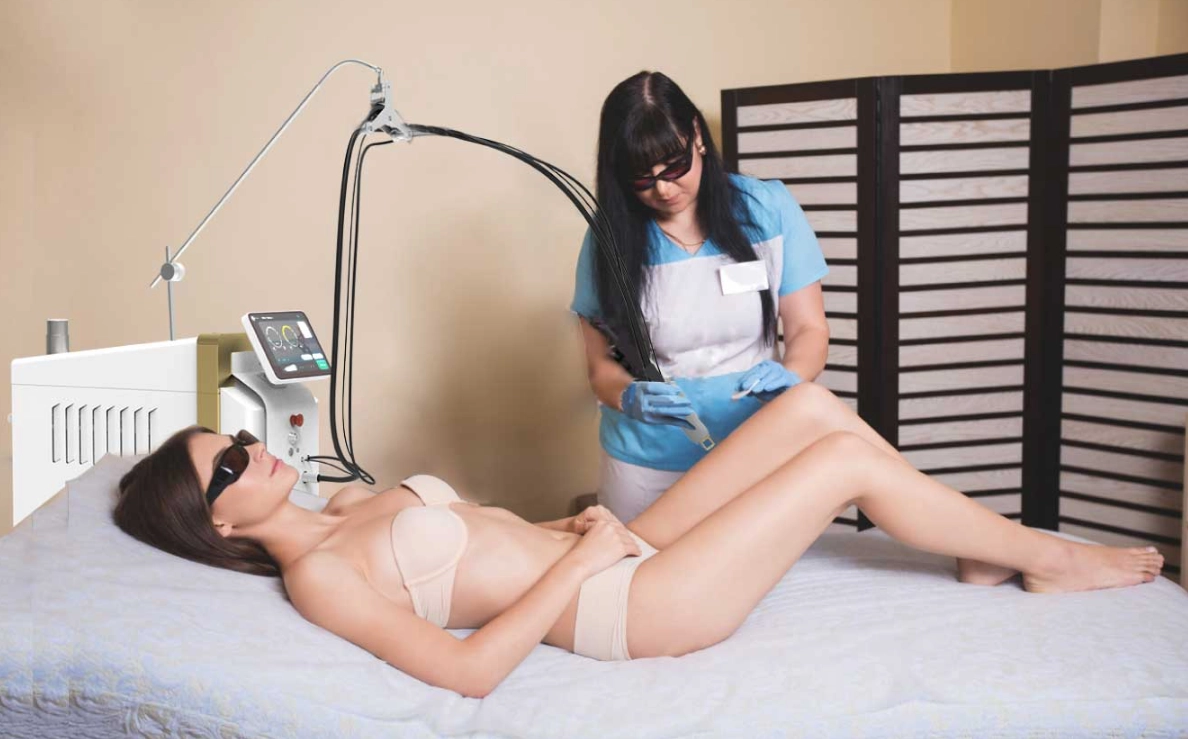
A professional platform may contain two laser sources or wavelength modules inside one enclosure. The optical path directs the selected beam to the handpiece. Control electronics coordinate emission and fault protection.
This integration matters on the treatment floor. The operator does not move between consoles. One interface can hold presets and shot information. It can show cooling controls and safety prompts. If the beam path drifts, output may not match the setting.
Wavelength selection
The operator selects a wavelength after reviewing skin type and hair characteristics. Treatment depth and area also matter. A pale leg with coarse hair may require a different setting from an underarm area on darker skin.
Good systems make the selection visible. The screen should show the active wavelength and key parameters. Clear labeling reduces mistakes when the room is busy.
Sequential or synchronized delivery
There are two common ways to use both channels. In sequential delivery, the system fires one wavelength and then the other according to a defined protocol. In synchronized delivery, software coordinates the timing of the pulses within a programmed sequence.
The meaning of “synchronized” depends on the manufacturer’s architecture. It does not prove that two beams hit the same spot at exactly the same instant. Buyers should ask how timing and presets are configured.
Shared parameter control
A dual-wavelength platform coordinates fluence with pulse duration. Repetition rate and spot size are managed alongside cooling intensity. These settings shape energy delivery and surface heat removal.
Cooling deserves attention. A capable design supports comfort during sessions and helps when switching wavelengths.
What Does a Typical Dual-Wavelength Treatment Workflow Look Like?
- Patient and skin assessment – Review skin and hair. Check recent sun exposure. Record treatment history and contraindications.
- Wavelength selection – Choose Alexandrite or Nd:YAG. A programmed combination may fit the treatment profile.
- Parameter adjustment – Set fluence and pulse width. Adjust repetition rate. Set spot size and cooling according to the device protocol.
- Test spot and treatment delivery – Check the response when appropriate, then deliver controlled pulses.
- Post-treatment guidance – Provide aftercare instructions and record settings for the next visit.
Training remains essential. A dual-wavelength device expands options; it does not replace clinical judgment.
Why Is a Two-Wavelength Platform Valuable for Clinics and Distributors?
For a clinic, one platform can cover more patient profiles without occupying two treatment rooms. Staff can adapt plans as hair density and skin tone change.
For distributors, the product is easier to position as a flexible professional system. A platform supporting 755 nm and 1064 nm fits clinics with mixed demand. Private-label buyers may adjust the housing and software language. Accessories can be customized. Packaging and documentation can be matched to the target market.
What Should B2B Buyers Check Before Sourcing an Alexandrite Nd:YAG Laser?
Brochure language can look impressive. Procurement decisions need detail.
Technical specifications
Check confirmed 755 nm and 1064 nm output. Review fluence range and pulse duration. Check repetition rate and spot sizes. Inspect handpiece design and cooling method. Ask for handpiece test data rather than a source-module headline.
Quality and compliance
Request market-specific regulatory documentation. This may include FDA, MDR, or CE records. Review electrical safety tests and laser controls. Check calibration procedures and manuals. Credentials should match the exact model and configuration.
OEM/ODM and after-sales support
OEM and ODM projects need more than a logo. Discuss enclosure changes and software languages. Cover packaging and labeling. Confirm spare parts, training, warranty terms, and response time. Established laser device R&D support helps with revised handpieces or market-specific interfaces.
Export projects also benefit from a defined after-sales service program. Confirm how issues are logged.
FAQ: Alexandrite Nd:YAG Laser Questions
Q: Can one device use both wavelengths in the same treatment?
Some systems support sequential or synchronized protocols. Modes depend on optical design and software. Confirm the function in the manual or a product demonstration.
Q: Which wavelength is better for darker skin?
1064 nm Nd:YAG is often considered because it has lower epidermal melanin absorption. The correct choice still depends on assessment and settings.
Q: Is a dual-wavelength laser suitable for OEM or private-label projects?
Yes, when the supplier maintains stable output while supporting customization. Review documentation and production controls. Check samples and service capability before scaling an order.
Conclusion
An Alexandrite Nd:YAG platform combines two absorption and penetration profiles in one controlled system. The engineering behind the sources and timing matters. So do cooling and interface design.
For clinics and distributors, custom OEM/ODM laser equipment can be evaluated around real treatment needs. Private-label brands can use the same route. Contact Altolumen’s technical team to discuss specifications and compliance documents. Sample evaluation and an export-ready project can follow.
Table of Contents
Categories
Recent Posts
How Does an Alexandrite Nd:YAG Laser Combine Two Wavelengths

How Does an Alexandrite Laser Hair Removal Machine Treat Coarse Hair?
How Does a Diode Hair Removal Machine Compare with IPL
FAQ
1. Why choose us ?
2. What is the payment method ?
3. When will the goods be delivered ?
4. What about the warranty?
5. How about delivery?
6. Do you have timely technical support?
Get a Free Quote