
-
 yazar
- 12th Kasım 2026
Two picosecond laser quotations can look nearly identical at first: both advertise a short pulse width, dual wavelengths and adjustable spots. Yet one may describe the full configuration offered to a clinic, while the other gives only the highest values from a product brochure. The risk is not simply paying more. It is choosing equipment without knowing how its quoted capabilities fit the services the clinic intends to provide.
The right comparison starts with a use case, then connects pulse width and energy to the wavelength, spot and operating conditions that will actually be supplied. Altolumen’s picosecond laser range provides a practical example, but the same method works when comparing quotes from different manufacturers.
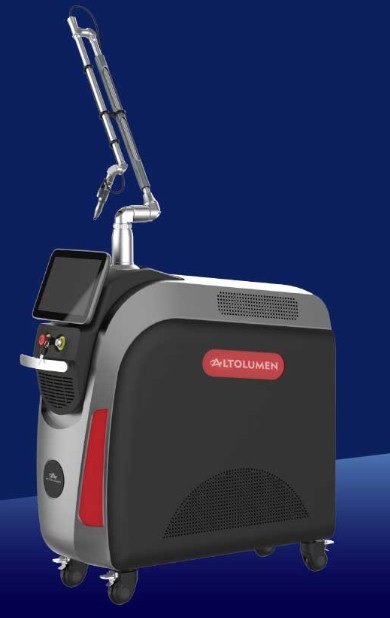
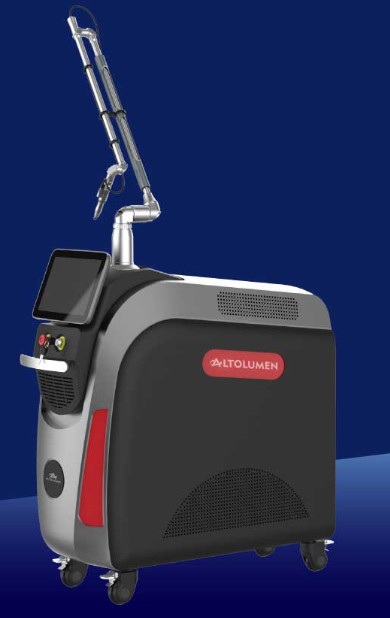
Altolumen picosecond laser system shown in the manufacturer’s product material.
Start With the Clinic’s Service Plan
Before comparing maximum energy or the shortest advertised pulse, specify the work the system needs to support. A clinic primarily evaluating tattoo-removal services may have different questions from a buyer considering a wider range of pigment-related procedures. A distributor also needs to know which configurations and documents are suitable for the countries in which it plans to sell. Indications and permitted use must be assessed against the relevant device documentation and local requirements.
Consider two suppliers offering machines labelled “350 ps.” If Supplier A confirms the output range for each included wavelength and handpiece, while Supplier B gives one impressive maximum value without saying how it was measured, the two quotes are not yet equivalent. Supplier B might still have a suitable machine; its quotation simply does not give the buyer enough information to make a defensible decision.
That distinction changes the conversation. Instead of asking for a better-looking number, the clinic can ask for a demonstration of the exact quoted configuration and a clear list of the accessories, settings and services included in the price.
What Do Pulse Width and Energy Actually Tell a Buyer?
Pulse width is the duration of an individual laser pulse. A figure of 350 ps means 0.35 nanoseconds; it is not a measure of how much energy reaches the treatment area. Pulse energy, normally expressed in millijoules (mJ), answers a different question. Neither number by itself establishes treatment results, operating flexibility or safety.
For purchasing, pulse width becomes useful when the supplier states which pulse-width option is fitted to the model and how that value is defined or verified. Pulse energy becomes useful when the quote identifies the available range at a given wavelength and output configuration. Comparing a short pulse on one brochure with a high energy number on another, without those conditions, is a poor basis for choosing between devices.
The same caution applies to watts. Altolumen’s published product specification includes a 2000 W figure, but the public listing does not specify whether it is electrical input or another power rating. It should not be mistaken for optical energy in each pulse at the treatment handpiece.
Use Wavelength, Spot Size and Rate to Test the Quotation
A clinic evaluating a dual-wavelength system needs to know what is available at each output, rather than assuming both wavelengths share the same maximum energy. Spot size adds another practical consideration: changing the diameter changes the area over which a pulse is delivered, and a machine may limit available energy at different spots. Repetition rate matters because the highest advertised energy may not be available at every rate.
A buyer does not need a long physics calculation to recognize the risk. The more useful step is to compare a few representative configurations relevant to the clinic’s intended services. If one quote lists “maximum energy” without a wavelength, spot size or repetition rate, ask for the conditions behind that claim. If the other quote states those conditions, its specification is easier to assess—even if its headline maximum looks lower.
Altolumen’s 350PS Model: A Practical Comparison Example
On Altolumen’s 350 PS Pikosananiye Lazer Dövme Silme Cihazı page, the listed models are CM-SP-1064&532 and PQS-A01. The public specifications include 300, 350, 400 and 450 ps pulse-width options; 532 nm and 1064 nm wavelengths; 2–10 mm spot sizes; and a frequency range of 1–10. The energy figures are separated by wavelength, which is particularly helpful when comparing offers.
|
Official listing |
What it means for the quote |
What to confirm |
|---|---|---|
|
1064 nm: 50–500 mJ |
Energy is wavelength-specific |
Included output and applicable operating conditions |
|
532 nm: 25–250 mJ |
Do not carry over the 1064 nm maximum |
Included output and applicable operating conditions |
|
300/350/400/450 ps options |
One headline value does not define every unit |
Pulse-width option supplied with the ordered model |
|
2–10 mm spots; 1–10 frequency |
Ranges are not a promise of every combination |
Spot, energy and rate available together |
These are manufacturer-published figures, not an independently verified performance report. The page does not establish that the highest energy, the shortest pulse, the largest spot and the fastest repetition rate can all be used at the same time. A clinic should judge the quoted configuration by the operating combinations it is actually offered, not by stacking separate maximum values.
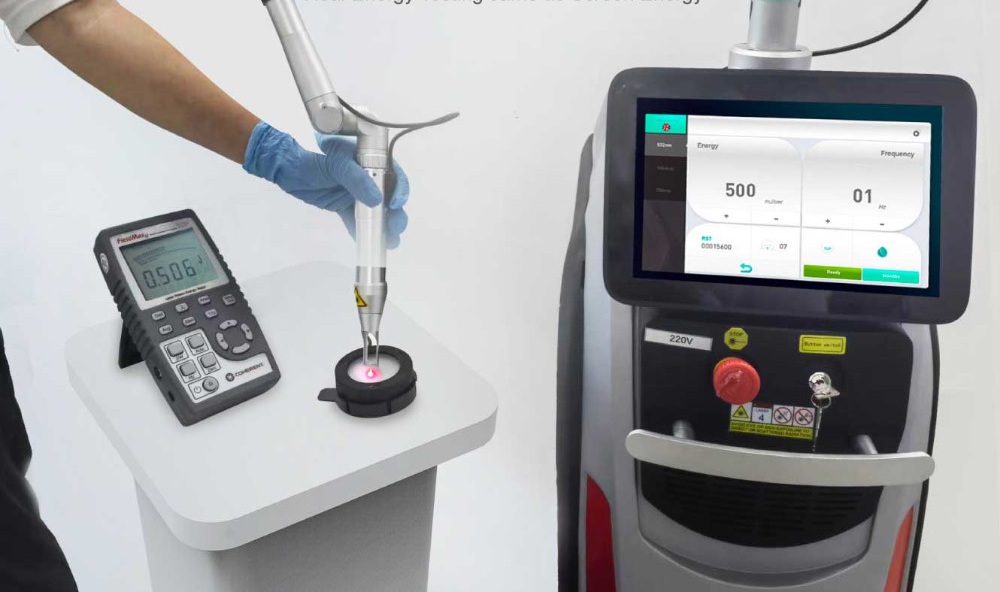
Manufacturer-provided energy-testing photograph. The picture illustrates a test setup; it is not a substitute for a model-specific test report.
What a Useful Demonstration Should Show
A live or recorded demonstration can answer questions a brochure cannot. The clinic should be able to identify the machine being demonstrated, see how the operator switches between included wavelength options, and observe how spot and energy choices are displayed. The handpiece reach, screen visibility and room layout can matter as much to daily operation as a published specification.
If the supplier presents a meter reading, it is reasonable to ask which configuration produced it. A single photograph or display reading should not be presented as proof of performance across the full range. Where an acceptance test forms part of the purchase, the parties can agree on the test method and relevant configurations before shipment. This is a practical purchasing safeguard, not a claim about clinical outcomes.
Compare the Delivered Package, Not Just the Machine
The technical comparison still needs to lead to a commercial decision. Two quotations may differ because one includes additional handpieces, on-site training or a longer service package, while the other prices those items separately. A buyer should have those differences visible alongside the equipment configuration, so an apparently cheaper system does not become an unexpected installation or support cost.
For the final review, the clinic can reduce the RFQ to four decisions: which model and output options will be delivered; which representative operating combinations are supported; what demonstration or test evidence is available for that configuration; and what installation, training, warranty and spare-parts terms are included. This is usually more useful than requesting a very long table of disconnected measurements.
For a deeper explanation of how pulses interact with tattoo pigment, see Altolumen’s existing guide to picosecond laser tattoo treatment. That discussion is separate from the present task: deciding whether a supplier’s equipment quotation is complete and comparable.
Çözüm
When comparing picosecond laser machines, the most useful specification is not always the largest number in the brochure. A buyer gains more from knowing what each value refers to, which combinations the quoted machine can deliver and how the equipment will work in the intended clinic. That makes the final decision easier to explain to practitioners, procurement colleagues and distributors alike.
To compare an Altolumen configuration with a current supplier quote, send the planned applications, destination market and required accessories through the Altolumen contact page. Ask for a model-specific response rather than relying on a generic maximum-value table.
SSS
Is a 350 ps machine automatically better than a 450 ps machine?
No. Pulse width is one characteristic of the system. The configuration, available pulse energy, wavelengths, controls, service support and evidence for the quoted unit also matter. A smaller pulse-width number alone cannot establish a better clinical or purchasing outcome.
Why are energy figures listed separately for 532 nm and 1064 nm?
Because the outputs can have different available energy ranges. Altolumen’s public page lists 50–500 mJ at 1064 nm and 25–250 mJ at 532 nm. A quotation should make clear which output its energy number describes.
Does a published 2–10 mm spot range prove every energy setting works at every spot?
No. The specification lists the available range, not all simultaneous operating combinations. Buyers should evaluate the combinations relevant to the intended services and confirm the quoted handpiece configuration.
What is the most important question to ask before ordering?
Ask the supplier to identify the exact machine and accessories being delivered, then show which operating configurations are supported and what training, service and documentation are included. This links the technical discussion to the actual purchase.
İçindekiler
Kategoriler
Son Yazılar
SSS
1. Neden bizi tercih etmelisiniz?
2. Ödeme yöntemi nedir?
3. Mallar ne zaman teslim edilecek?
4. Peki ya garanti?
5. Peki ya teslimat?
6. Zamanında teknik destek sağlıyor musunuz?
Ücretsiz Fiyat Teklifi Alın