
-
 autore
- 2nd Ottobre 2026

A picosecond laser tattoo removal machine breaks down ink by delivering energy in pulses that last only a few hundred picoseconds. The short pulse creates rapid pressure inside or around pigment particles, producing a photomechanical fracture rather than relying mainly on prolonged heating. The fragments are then gradually cleared by the body’s normal transport and elimination processes. In practice, wavelength, pulse width, fluence, spot size, ink depth, tattoo composition, and skin response all influence the result.
How Does a Picosecond Laser Break Down Tattoo Ink?
Think of the process as a controlled energy to particle sequence:
- The pigment absorbs selected light.Wavelength is chosen for the ink’s absorption, depth, skin context, and any mixed colors.
- The pulse arrives before heat spreads widely.Energy is deposited quickly, creating a sharp pressure rise while thermal diffusion remains limited during the pulse.
- Stress fractures the pigment.Rapid expansion around the absorbing particle creates a mechanical stress wave; when it exceeds the particle’s tolerance, the particle breaks into smaller fragments.
- The skin clears the fragments.Immune and lymphatic pathways transport some fragments, while superficial material can leave through epidermal turnover. This takes time.
That is why a shorter pulse is useful but not sufficient by itself. A machine also needs an appropriate wavelength, adjustable energy, stable beam delivery, suitable spot sizes, and an operator who can assess tissue response. Altolumen’s picosecond laser systems provide the relevant product context.
Which Laser Physics Fragments Tattoo Ink?
Evaluate the mechanism as four linked effects:
Absorption: Ink compounds absorb wavelengths differently. The goal is to concentrate the effect in pigment while limiting unwanted energy in surrounding tissue.
Stress confinement: When the pulse is shorter than the time required for stress to relax or heat to diffuse, the target experiences high peak stress. This is why the effect is described as photomechanical or photoacoustic rather than simply thermal.
Fragmentation: The pressure wave can crack pigment agglomerates and reduce particle size. Chemistry, binder, depth, previous fading, and tissue conditions affect how uniformly this happens.
Tissue limits: The target is living skin, so energy must be selected with epidermal and dermal response in mind. A qualified practitioner must follow local protocols, eye protection, protection measures, and aftercare.
This is why pulse duration alone is a weak comparison. A Q switched Nd:YAG platform and a picosecond platform may share a wavelength but have different temporal profiles. Compare the complete operating envelope: wavelength, pulse control, energy, spot sizes, beam delivery, and documentation. See Q switched Nd:YAG tattoo removal platforms as an adjacent technology.
How Do Wavelength and Spot Size Change Ink Breakdown?
Wavelength and spot size turn the mechanism into a selection decision. Altolumen lists 532 nm and 1064 nm options, with 532 nm described for several epidermal pigment colors and 1064 nm for deeper dark, blue, and gray applications. These are starting points, not universal recipes.
How Does Wavelength Match Ink Color and Depth?
Wavelength selection follows absorption and depth. A superficial red, yellow, purple, or brown component may differ from a deeper black, blue, or gray component. Mixed tattoos may need separate passes or conservative test spots; a wavelength range does not guarantee equal response for every color.
Why Does Spot Size Change Fluence and Coverage?
Spot diameter changes illuminated area approximately with its square. A 6 mm spot has four times the area of a 3 mm spot, because (6/3)^2 = 4. If energy stays constant while the spot shrinks, energy density rises. Re check fluence, coverage, overlap, skin response, and aiming after any change. Altolumen lists a 2–10 mm range for its 350PS equipment.
What Happens to Ink Particles After the Laser Pulse?
Fragmentation is the midpoint, not the endpoint. Immune cells can engulf fragments and move them through lymphatic pathways; superficial material may leave as the epidermis renews. Pace depends on particle size, chemistry, depth, density, location, immune response, and treatment interval.
Responsible protocols therefore use staged assessment rather than repeated high energy at short intervals. The practitioner watches skin response, allows recovery, and evaluates fading before selecting the next parameters. A device cannot promise a universal session count or identical clearance rate.
What Should Buyers Check Before Requesting a Picosecond Laser Quote?
Use this checklist when comparing a picosecond laser tattoo removal machine:
- Pulse width and wavelengths:Confirm the pulse range, available wavelengths, selection method, and documented optics.
- Energy, frequency, and spots:Ask for usable ranges, display limits, spot diameters, and how energy density changes with size.
- Beam and safety:Review aiming beam visibility, beam delivery stability, eye protection, skin protection guidance, emergency controls, and training.
- Support and workload:Ask about duty cycle, maintenance, spare parts, installation, troubleshooting, and local compliance documents.
- Application fit:Send representative colors, depth, tattoo size, workload, and target markets instead of requesting a generic configuration.
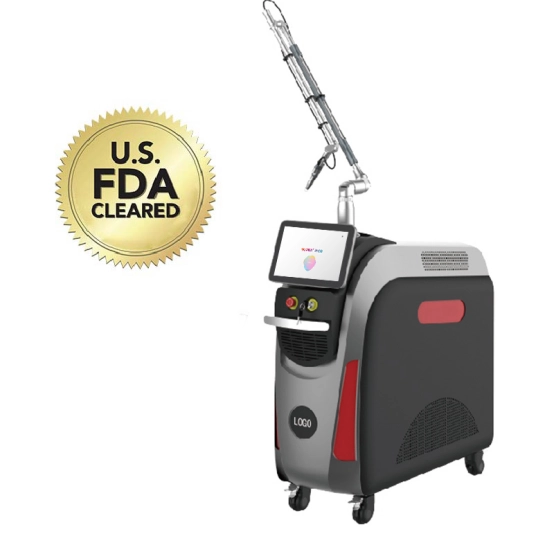
For a 350PS configuration, verify the stated 350 ps positioning, 532/1064 nm wavelengths, energy, frequency, and 2–10 mm spot range against your workflow and local requirements. The 350PS picosecond laser tattoo removal equipment reference can organize the review.
FAQ
The following questions address common technical edge cases that remain after the main mechanism and purchasing checks.
Does a Picosecond Laser Remove Ink Mainly through Heat?
No. The intended primary effect is rapid photomechanical stress and fragmentation. Some heat is generated, so tissue protection still matters, but the short pulse limits thermal diffusion compared with a heat dominant approach.
Is 532 Nm or 1064 Nm Better for Every Tattoo?
Neither is universal. Wavelength must match pigment absorption, depth, skin context, and the rest of the tattoo. Mixed color work may need different settings or passes and a conservative test approach.
How Many Sessions Does Picosecond Tattoo Removal Require?
There is no universal count. Ink load, color, depth, age, location, immune clearance, previous treatments, and safe spacing all change the course. Any published range is an example, not a clinical guarantee.
How Is Picosecond Different from Nanosecond Tattoo Removal?
Picosecond pulses are shorter and emphasize rapid photomechanical fragmentation, while nanosecond systems rely more on thermal confinement. Outcomes still depend on wavelength, fluence, spot size, pigment chemistry, tissue response, and technique.
What Information Should You Send for a Picosecond Laser Quote?
For a useful compatibility review, send treatment and configuration details such as representative ink colors, estimated depth, indications, workload, target markets, compliance needs, and preferred wavelength or spot size range. That information supports a more defensible configuration discussion than a generic price request.
Sommario
Categorie
Articoli recenti
How Does a Picosecond Laser Tattoo Removal Machine Break Down Ink?
How Does a Picosecond Laser Machine Treat Tattoos

Come fa un laser Nd:YAG ad Alessandrite a combinare due lunghezze d'onda?
FAQ
1. Perché scegliere noi?
2. Qual è il metodo di pagamento?
3. Quando verrà consegnata la merce?
4. E per quanto riguarda la garanzia?
5. E per quanto riguarda la consegna?
6. Offrite un supporto tecnico tempestivo?
Richiedi un preventivo gratuito